How Often Should You Change Aquarium Water? A Complete Guide
Keeping an aquarium clean is one of the most important parts of taking care of your fish. While your aquarium filter helps remove waste and keeps the water moving, it cannot replace regular water changes.
So, how often should you change aquarium water? For most healthy, established freshwater aquariums, a partial water change of around 20–30% once a week is a good general starting point. However, the ideal schedule can vary depending on your fish, tank size, stocking level, plants, filtration, and water test results.
In this guide, we’ll explain how often to change aquarium water and how to do it safely.
Why Do Aquarium Water Changes Matter?
Fish naturally produce waste, and uneaten food and decaying plant material can also contribute to waste in the aquarium.
Beneficial bacteria in the biological filter help process toxic ammonia and nitrite, but regular water changes help remove nitrate and other dissolved substances that can accumulate over time.
Regular water changes can help:
- Maintain better water quality
- Reduce nitrate buildup
- Remove dissolved waste
- Replenish some minerals
- Support fish health
- Keep the aquarium looking cleaner
Remember that clear aquarium water doesn’t always mean the water is healthy. Testing your water is an important part of aquarium care.
How Often Should You Change Aquarium Water?
For Most Established Freshwater Aquariums
A 20–30% partial water change once a week is a useful starting point for many community aquariums.
However, you may need to adjust the frequency depending on your aquarium’s conditions.
Smaller or Heavily Stocked Aquariums
Smaller tanks and aquariums with a high number of fish can accumulate waste more quickly.
You may need to perform water changes more frequently if testing shows that nitrate is rising too quickly or other water-quality problems are developing.
Planted Aquariums
Live plants can absorb nutrients and help contribute to a healthy aquarium ecosystem, but planted tanks still require water changes.
The exact schedule depends on plant density, fish stocking, fertilization, filtration, and water-test results.
New Aquariums
Newly established aquariums require extra attention because the biological filtration system is still developing.
During the cycling process, regularly test ammonia and nitrite and follow an appropriate cycling plan. Don’t rely on a fixed weekly schedule alone if your test results indicate a problem.
How Much Water Should You Change?
For routine maintenance, changing around 20–30% of the aquarium water is a common approach.
For example:
- 20-liter aquarium → change about 4–6 liters
- 50-liter aquarium → change about 10–15 liters
- 100-liter aquarium → change about 20–30 liters
These are general examples, not strict rules. Your water-change schedule should be based on the aquarium’s individual needs.
How to Change Aquarium Water Safely
Changing aquarium water doesn’t have to be difficult. Follow these simple steps.
Step 1: Prepare the New Water
Prepare enough fresh water for the amount you plan to replace.
If you’re using tap water, treat it with an appropriate water conditioner to neutralize chlorine and chloramine according to the product instructions.
Try to make the new water reasonably close to the aquarium’s temperature to avoid unnecessary temperature stress.
Step 2: Turn Off Equipment
Before removing water, switch off equipment such as the heater and filter when appropriate, particularly if the water level will fall below the equipment’s operating requirements.
Step 3: Remove the Old Water
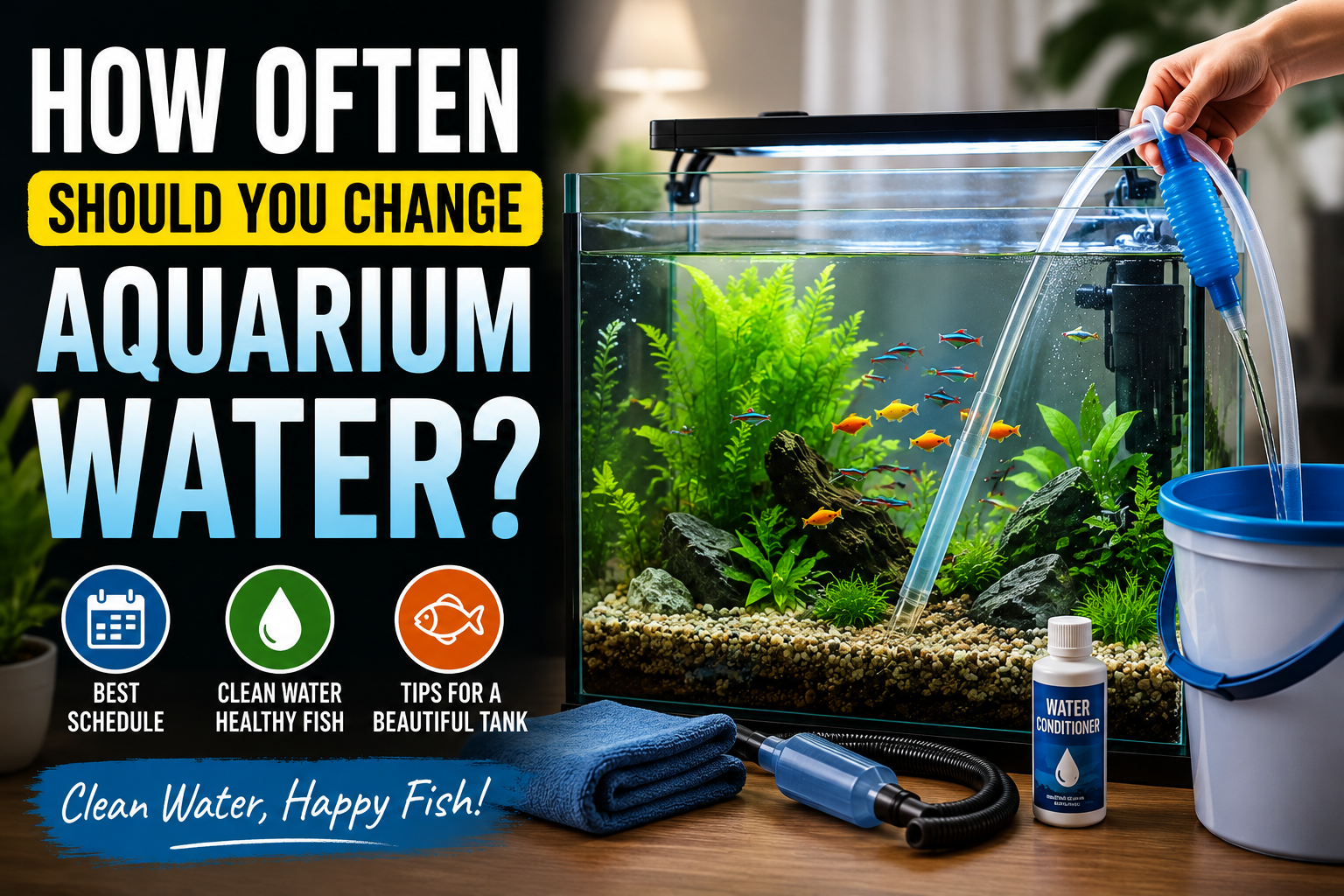
Use an aquarium siphon or gravel vacuum to remove the desired amount of water.
While doing this, you can gently vacuum debris from the substrate.
You don’t need to remove all the water. Partial water changes are normally preferable for routine maintenance.
Step 4: Add the Fresh Water
Slowly add the prepared water back into the aquarium.
Pour gently to avoid disturbing plants, decorations, and substrate.
Step 5: Turn the Equipment Back On
Check that your filter, heater, and other equipment are operating correctly after the water change.
Should You Remove the Fish During a Water Change?
Usually, no.
For a normal partial water change, fish can generally remain in the aquarium. Removing them can cause additional stress and isn’t necessary for routine maintenance.
Instead, work carefully around your fish while siphoning and adding fresh water.
Should You Change 100% of the Aquarium Water?
A complete water change is not normally necessary for routine aquarium maintenance.
Removing all the water can cause unnecessary stress to fish and can disrupt the aquarium’s established environment.
Instead, regular partial water changes are generally a better approach.
There can be unusual situations where a very large water change is necessary, such as certain water-quality emergencies. In those cases, the appropriate response depends on the specific problem and water-test results.
Don’t Forget to Test Your Aquarium Water
One of the best ways to determine whether your aquarium maintenance routine is working is to test the water regularly.
Important parameters to monitor include:
- Ammonia
- Nitrite
- Nitrate
- pH
If nitrate consistently rises too quickly, or ammonia or nitrite is detected in an established aquarium, investigate the cause rather than simply following a calendar-based water-change schedule.
Possible causes include overfeeding, overstocking, inadequate filtration, or problems with the biological cycle.
Common Aquarium Water-Change Mistakes
❌ Changing all the water unnecessarily
Routine maintenance usually requires partial rather than complete water changes.
❌ Adding untreated tap water
Chlorine and chloramine can be harmful to fish and beneficial bacteria. Always use an appropriate water conditioner when required.
❌ Adding very cold or very hot water
Large temperature differences can stress fish. Try to match the new water temperature as closely as practical.
❌ Over-cleaning the aquarium
Your aquarium contains beneficial microorganisms that are important for biological filtration. Avoid aggressively cleaning everything at once.
❌ Ignoring water tests
Don’t judge water quality only by how clear the aquarium looks.
What About the Aquarium Filter?
Your filter needs maintenance too, but avoid washing biological filter media under untreated tap water.
If the filter media needs cleaning, gently rinse appropriate media in removed aquarium water when possible. Follow the filter manufacturer’s recommendations and avoid replacing all biological media at once unless there is a specific reason to do so.
A Simple Aquarium Maintenance Schedule
For many established freshwater community aquariums, a simple routine might look like this:
Every day
- Check fish behavior
- Check that equipment is working
- Feed an appropriate amount
Every week
- Test water as needed
- Perform a partial water change
- Remove visible debris
- Check equipment
Every month
- Inspect filter and other equipment
- Review water-quality trends
- Trim plants if necessary
- Check that the aquarium isn’t becoming overcrowded
The exact schedule should always be adjusted according to your aquarium’s needs.
Final Thoughts
Regular water changes are an essential part of keeping an aquarium healthy. For many established freshwater aquariums, changing around 20–30% of the water once a week is a useful starting point.
However, every aquarium is different. Fish species, tank size, stocking levels, filtration, plants, feeding habits, and water-test results should all influence your maintenance routine.
The most important rule is simple: don’t wait until the water looks dirty to change it. Regular maintenance and water testing can help create a cleaner, more stable environment where your fish can thrive.
Healthy water means happy fish! 🐠💧🌿